MV-Forcing
Long Multi-View Video Generation via 4D-Grounded
Spatio-Temporal Self-Forcing
ECCV 2026
TL;DR We present the first framework for long multi-view video generation by composing
temporal and view-wise autoregression with a 4D geometric prior.
Abstract
Recent advances in video diffusion models have enabled either long single-view generation through temporal autoregression, or short multi-view synthesis through bidirectional attention. However, generating long, multi-view consistent videos of dynamic scenes remains unsolved. In this work, we present MV-Forcing, a framework that composes temporal and view-wise autoregression within a single diffusion model by introducing a 4D geometric bridge between sequentially generated views. Our key insight is that an autoregressive 3D reconstruction model naturally interfaces between autoregressively generated views. Given a completed source view, we reconstruct its 3D structure and render a geometric prior of the next target viewpoint, which the diffusion model refines into a high-quality video. To extend generation beyond the teacher's fixed temporal window, we introduce a joint denoising regime where both view slots are initialized from noise during training, enabling temporally unbounded generation. We distill the model via Distribution Matching Distillation with Spatio-Temporal Self-Forcing, closing the train-inference exposure bias gap for both temporal and view-sequential autoregression. Extensive experiments on both synthetic and real-world data demonstrate that MV-Forcing produces geometrically consistent multi-view videos of dynamic scenes at arbitrary lengths and viewpoint counts using a single few-step student model.
Results
Each video shows 3 synchronized views generated from a single text prompt.
"A woman in a black tank top practices yoga on a mat in a sunlit living room."
"A couple sitting on a blanket on a sandy beach, the woman in a white dress gesturing towards the ocean under a sunset."
"A woman in a red sweater sitting on the floor holding a present by a fireplace and Christmas tree."
"A woman with dark hair and makeup turning her head in a dramatic black and white close-up portrait."
"A man in a black tracksuit stretches and squats on a rooftop."
"A pedestrian crossing signal on a city street pole with buildings and trees in the background."
"A curly-haired boy and a girl with long hair playing a video game in a colorful indoor arcade."
"A colorful globe spinning against a black background."
How does it work?
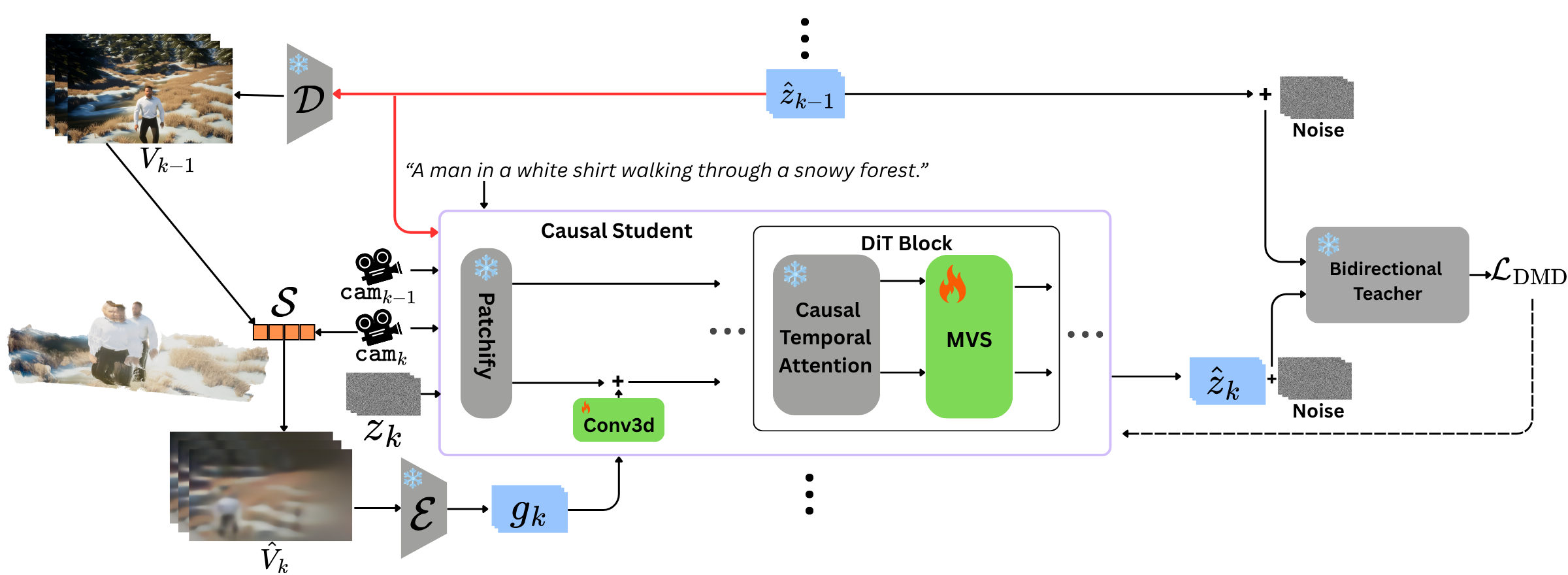
🎥 We compose temporal and view-sequential autoregression within a single diffusion model,
generating video blocks sequentially along both time and viewpoints using a causal few-step student
distilled from a bidirectional teacher.
🌍 Each generated block is fed into CUT3R, a recurrent 3D reconstruction model that accumulates
a persistent geometric state encoding the 4D structure of the scene from all previously generated
content across both axes.
🔍 When generating the next view, the accumulated state is queried from the target camera
to produce a geometric prior that grounds the generation in the full scene geometry observed so far.
📋 See our paper for details on how Spatio-Temporal Self-Forcing closes the train-inference
exposure bias gap along both axes, enabling generation at arbitrary length and viewpoint count.
BibTeX
@misc{fiebelman2026mvforcinglongmultiviewvideo,
        title={MV-Forcing: Long Multi-View Video Generation via 4D-Grounded Spatio-Temporal Self-Forcing},
        author={Gal Fiebelman and Hadar Averbuch-Elor and Sagie Benaim},
        year={2026},
        eprint={2607.05376},
        archivePrefix={arXiv},
        primaryClass={cs.CV},
        url={https://arxiv.org/abs/2607.05376},
    }